
Make the first system work
A stable local assistant on the first Spark, with internal test-data AI search ready for engineers.
- Spark bring-up + local model connection
- Internal test-data AI search
- Baseline speed, reliability, and answer tests
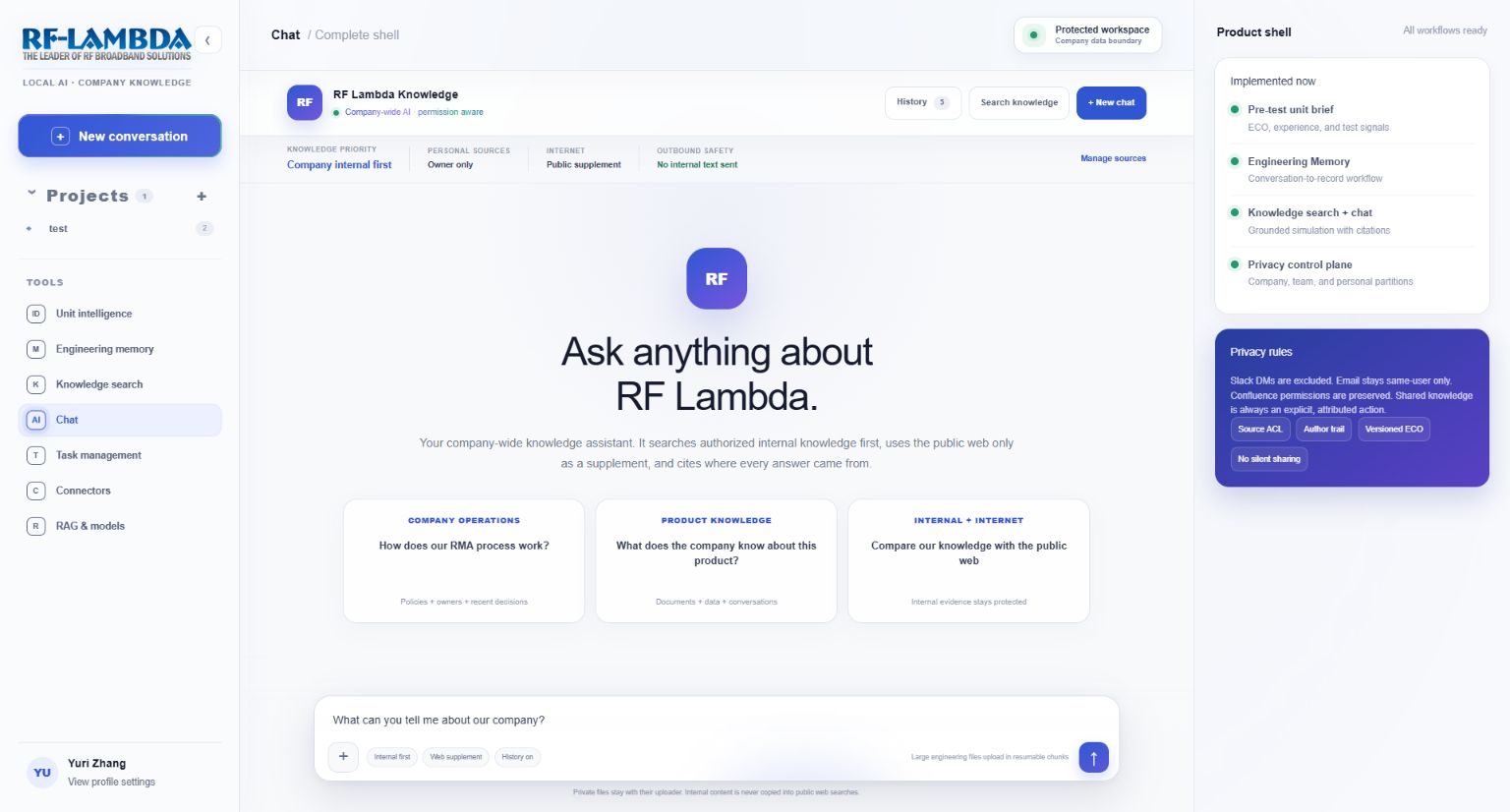
A fully local, role-aware AI platform for every authorized RF Lambda employee— grounded in company knowledge and designed to keep internal data inside.
Engineer / Test · Authorized company scope
I reviewed the current work instruction, active ECOs, the authorized unit record, prior test history, and the latest schematic.

Give every authorized employee a faster way to find answers, prepare work, and use company knowledge safely.
Clear deployment boundary. This public plan and the hosted prototype are presentation and validation environments. The production model and protected company sources are intended to stay inside RF Lambda-controlled infrastructure.
The current team is Yuri and Darlene. Both can build the software; ownership has not been divided yet. This baseline shows the work and sequence without inventing assignments.
Planning baseline, not a fixed commitment. Dates will be recalibrated after the first local-model bring-up. Owners will be added only after Yuri and Darlene agree on the task split.
A stable local assistant on the first Spark, with internal test-data AI search ready for engineers.
Employees receive cited answers from approved company sources, and restricted information stays restricted.
The assistant can prepare a pre-test brief and understand approved PDFs, images, PCBs, and schematics.
A limited cross-role trial shows whether the platform saves time, protects data, and is ready for wider company use.
Dates and sequencing will be recalibrated as evidence arrives. Names will be added to individual workstreams only after responsibilities are agreed.
This is the target employee experience. The current prototype already checks identity, administrator access, personal files, and project membership. Department-level rules are the next security stage.
Use RFLUPAEXAMPLE1 Rev 6. Before test, confirm ECO-1187, calibration status, prior failure signatures, and the unit’s authorized DataFinder record.
The plan focuses on visible workplace results: faster answers, safer access, fewer missed requirements, and less time spent hunting for information.
Ask questions in normal language and receive cited answers from the company information that person is allowed to see.
FOUNDATION WORKINGCollect the ECOs, instructions, prior signals, calibration checks, and cautions relevant to a part before test.
NEXT WORKFLOWUse the proven DataFinder read-only path to search by part number, serial number, or work order through the AI platform.
CONNECTEDAsk questions about PDFs, images, PCB layouts, circuit diagrams, and other common engineering files.
UPLOAD READY · AI REVIEW NEXTTrack work, ownership, deadlines, decisions, and project context in one place.
WORKING PROTOTYPEShare project-scoped context while preserving personal, team, project, and company access boundaries.
FOUNDATION WORKINGThe prototype now supports real workspace actions, safe internal test-data lookup, a local-model connection path, and an initial quality baseline.
WORKING PROTOTYPEProjects, tasks, chat history, private files, feedback, and administration
CONNECTED READ-ONLYDataFinder search by part number, serial number, and work order
READY TO CONNECTA local-model interface for the first DGX Spark
INITIAL BASELINESix of six built-in answer checks passed; local-model testing comes next
Projects, task assignment, conversation history, project members, private files, audit records, feedback, and administrator status are implemented in the prototype.

The AI platform can already use DataFinder to find indexed unit records without changing the source data. The same search can be made available to engineers through normal questions.

Next proof point: run the real local model on the Spark and test it against approved company knowledge. File upload and permissions are ready; true AI understanding of PDFs, images, PCBs, and schematics is still upcoming work.
One DGX Spark is enough to prove the first working version. Seven to eight units is the current estimate for serving fewer than thirty people, but the purchase decision should follow measured employee demand, response speed, and reliability.
Track response time, wait time, reliability, and how many people can use the system together.
Use pilot demand to estimate the capacity needed for different teams and workflows.
Recommend additional units only when measured use shows the required capacity and resilience.
The pilot advances only when employees save time, answers are dependable, restricted information stays protected, and the service remains reliable.
Employees can verify the source and subject-matter experts judge the answer useful.
Role and project restrictions hold in every access test, with a clear audit trail.
The service stays responsive under realistic use and recovers predictably from problems.
People return to the tool, save measurable time, and complete work more easily.
